listicle
Rapid Prototyping Services: 7 Best Providers 2026

Last Updated: October 2, 2026
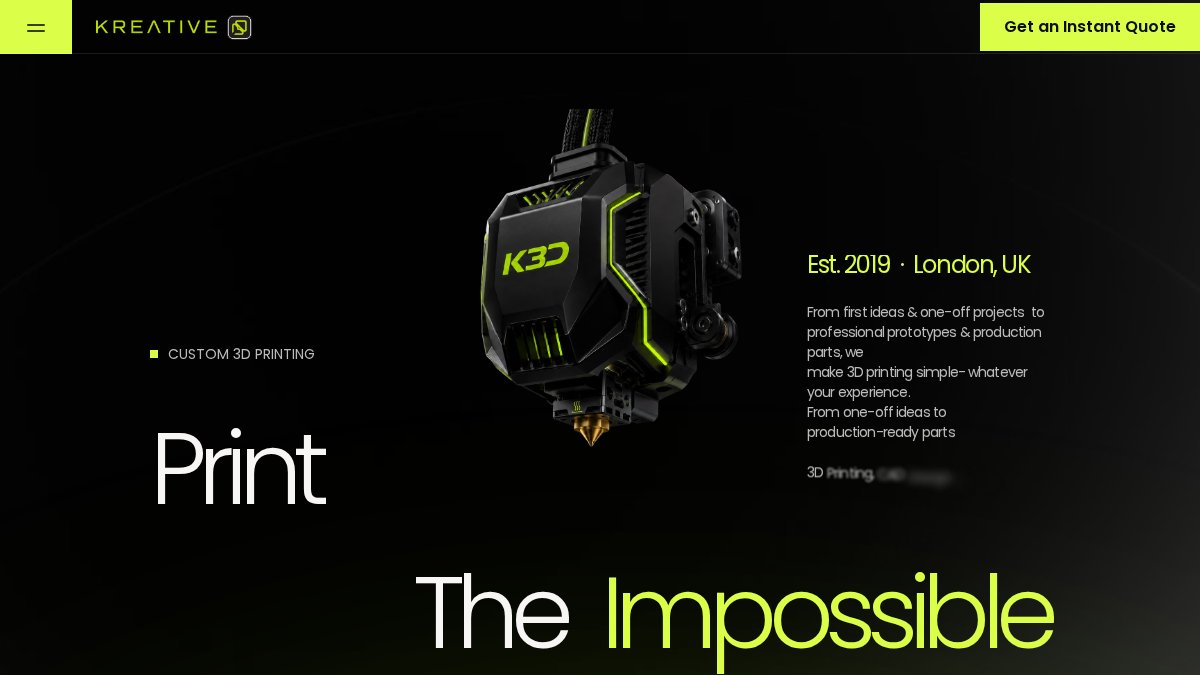
3D Printing London | CAD, Prototyping & Custom Parts | Kreative3D
Rapid Prototyping Services: What You Need to Know
Rapid prototyping has become essential for businesses that need to test ideas, validate designs, and move from concept to production quickly. Whether you're a product designer refining an MVP, an automotive restoration specialist sourcing obsolete parts, or a manufacturing firm needing custom tooling, the right rapid prototyping services can compress months of development into weeks.

Rapid Prototyping & 3D Printing Company UK | Prototype Projects
This guide covers turnaround times, material options, CAD expertise, and how to avoid overpaying for capabilities you don't need, then explains where each provider fits and the technical decisions that separate smooth prototyping from frustration.
Quick Comparison Table
Provider | Specialisation | Best For | Standout Strength |
|---|---|---|---|
Kreative3D | FDM, resin, metal printing + CAD | One-offs and small batches | Instant quoting and reverse engineering |
Prototype Projects | Industrial additive manufacturing | Complex geometry, high precision | Decades of finishing expertise |
Sculpteo | Online 3D printing service | Designers needing diverse materials | Advanced file analysis and repair tools |
Rapid Axis | CNC machining and rapid tooling | Metal and plastic precision parts | Tight tolerances and quality control |
NOBLE | CNC, vacuum casting, injection moulding | Bridge production runs | Versatility across manufacturing processes |
StudioRed | Full product design and engineering | Concept-to-prototype partnerships | Holistic design and iterative testing |
Zling Rapid Prototype | Five-axis CNC and supply chain | Complex industrial components | Advanced machining and logistics integration |
1. Kreative3D: Instant Quoting and Versatile Materials
Kreative3D removes friction from rapid prototyping: upload your CAD file, get an instant quote, and understand exactly what you're paying for. That transparency matters under deadline pressure.

Sculpteo website
They specialise in FDM, resin, and metal printing. FDM, resin, and metal printing support a wide range of needs from prototyping and custom one-offs to small-batch production runs.
Their CAD expertise and reverse engineering services save weeks of iteration for automotive restoration and legacy equipment applications.
Confirm turnaround times align with your deadline.
Pro Tip Kreative3D also operates a dedicated reef aquarium products section, custom-designed components tested and built to solve specific aquarium challenges. If you're in that niche, it's worth exploring their specialised offerings.

2. Prototype Projects: Industrial Precision and Finishing
They don't offer instant online quoting, but the detailed engineering review often prevents costly redesigns on complex projects.
Best For Engineering teams and manufacturers working on industrial components where precision, finishing quality, and technical guidance matter more than rapid turnaround.
3. Sculpteo: Professional-Grade Additive Manufacturing
They excel at additive manufacturing but don't offer CNC, vacuum casting, or injection moulding, you'll need a secondary partner for method transitions.
CAD Design for Prototyping: From Concept to Production
Strong CAD design determines success: well-structured files reduce manufacturing time and waste; poor files lead to rejected quotes and delays. Your CAD decisions directly determine which prototyping method is cost-effective.
Manufacturability and Method Selection
FDM is the budget choice (£30-150 per part) for simple geometry and loose tolerances (±0.5mm+). It struggles with fine detail, thin walls, and overhangs. Design for FDM by avoiding internal cavities without access holes, keeping walls above 2mm, and minimising overhangs.
Resin printing is the mid-range choice (£80-300 per part) for fine detail and tight tolerances (±0.2mm). It produces internal cavities and intricate features FDM cannot, but parts are brittle and unsuitable for load-bearing. Design with walls above 1mm and accept fragility.
CNC machining is the precision choice (£200-800+ per part) for tight tolerances (±0.1mm+) and structural strength. Design by specifying precision surfaces only, avoiding internal cavities without access holes, and minimising setups.
Tolerance Specification and Cost Impact
Specify tight tolerance only on surfaces that need it (mating surfaces, functional features). That distinction cuts costs 30-50% without compromising function.
FDM and resin printing offer various tolerance capabilities, with tighter tolerances often requiring additional processing.
Assembly Logic and Design for Manufacturing
Design multi-component prototypes with assembly in mind. For 3D printed parts, use snap fits to avoid fasteners. For multi-component prototypes, consider the assembly process during design.
Preparing CAD Files for Quoting
When submitting CAD, include: fully dimensioned drawings with critical tolerances, material specification, quantity, finish requirements, and deadline. Vague dimensions lead to conservative (higher) quotes.
Many providers offer CAD services. Kreative3D includes reverse engineering.
3D Printing Turnaround Times: What to Expect
Turnaround time includes design review, manufacturing, post-processing, quality checks, and delivery, not just printing. Understanding this breakdown prevents disappointment.
FDM: 5-10 business days end-to-end. Small prototypes print in 24-48 hours; larger parts take 3-5 days. Post-processing adds 1-2 days; regional delivery adds 1-2 days. Peak periods add 3-5 days.
Resin: 7-14 business days end-to-end. Printing takes 12-36 hours; post-processing (washing, curing, finishing) adds 3-5 days; finished prototypes add 2-3 days. Choose resin for production-ready appearance.
Metal Printing (Direct Metal Laser Sintering): 14-21 business days end-to-end
Metal printing is the slowest additive method. Printing itself takes 5-7 days (the laser must sinter metal powder layer by layer in a controlled atmosphere).
Metal printing is typically chosen when the part must be metal for functional reasons (thermal conductivity, strength, weight).
The Hidden Variable: Post-Processing Time
Raw 3D prints are rarely production-ready. Layer lines, support marks, rough surfaces, and dimensional inconsistencies require finishing work that most providers don't include in their "turnaround time" quote.
Kreative3D offers in-house finishing services, which consolidates the timeline and ensures quality.
London-Specific Logistics
If you're ordering from a provider within the region, same-day or next-day courier delivery is standard, adding only 1 business day.
For time-critical projects, verify the provider's location and courier options upfront. A provider 10 miles away with same-day delivery beats a national provider with 3-day turnaround, even if the per-part cost is slightly higher.
Choosing the Right Method by Deadline
If your deadline is 2 weeks or more: any method works. Choose based on material requirements and surface finish needs.
If your deadline is 1-2 weeks: FDM or resin printing with in-house finishing. Avoid metal printing unless it's non-negotiable.
If your deadline is under 1 week: FDM only, and order immediately. Even then, you're cutting it close. Confirm the provider can meet your date before ordering.
If your deadline is this week: rapid prototyping may not be suitable. Most rapid prototyping providers need a minimum of 3-5 business days.
Watch Out Don't assume "rapid" means "overnight." The fastest providers still need 3-5 business days minimum for manufacturing plus 1-2 days for delivery. If you're working to a deadline fewer than 5 business days away, confirm feasibility directly with the provider before ordering. Peak periods (September-October for trade shows, November-December for product launches) can stretch timelines by 50%, so order early during busy seasons.
Bespoke Resin Printing Services: Materials and Applications
Resin printing (stereolithography and digital light processing) occupies a sweet spot between FDM and CNC machining: faster than machining, higher precision than FDM, and better surface finish than either. For bespoke resin printing services, understanding material options and application limits prevents costly mistakes.
Standard resins (acrylics and epoxies) work for most prototyping. They're rigid, dimensionally stable, and accept paint and finishing well. If your prototype is a visual mockup or a functional test part that doesn't need to survive harsh conditions, standard resin is the right choice.
Specialist resins expand capability. High-temperature resins withstand 120-150°C, useful for components near heat sources. Flexible resins (TPU-like) create rubber-like prototypes for gaskets, seals, or ergonomic grips.
The limitation is strength. Resin parts are generally weaker than injection-moulded plastics or machined metals. They work for non-structural components, enclosures, and aesthetic mockups. If your prototype needs to bear load or survive repeated mechanical stress, test resin parts carefully before committing to production.
Surface finish is a major advantage. Resin prints emerge with smooth surfaces that require minimal post-processing. A light sanding and paint application deliver production-like aesthetics in days rather than weeks.
Bespoke resin printing services often include finishing options, such as sanding, painting, and coating, which adds cost but delivers a complete product rather than a raw print. Kreative3D offers finishing, and it's worth the investment if your prototype needs to look finished.
Choosing the right rapid prototyping service depends on three variables: your timeline, your material requirements, and your budget.
Get an instant quote from Kreative3D and see how quickly your prototype can move from CAD to finished part. Their FDM, resin, and metal printing capabilities, combined with reverse engineering and CAD services, cover the full range of rapid prototyping needs.
Frequently Asked Questions
What are the benefits of using rapid prototyping services instead of traditional manufacturing?
Rapid prototyping services compress development cycles from months to weeks. You iterate designs quickly, test functional prototypes before committing to expensive tooling, and validate market fit with physical samples. Additive manufacturing eliminates the lead time and setup costs of traditional injection moulding, making small-batch production economical and enabling reverse engineering for obsolete or custom parts.
How quickly can you actually get a prototype back with 3D printing turnaround times?
Turnaround times for 3D printing depend on complexity, material selection, and post-processing requirements. Instant online quoting systems can provide lead times before ordering. Lead time depends on queue depth, material selection, and finishing specifications, more intricate geometry or specialized materials may extend turnaround.
What's the difference between FDM, resin, and metal 3D printing for prototyping?
FDM (fused deposition modelling) is fastest and cheapest, ideal for form testing and assembly checks. Resin printing (SLA/stereolithography) delivers finer detail and smoother surfaces for visual prototypes and functional parts requiring precision. Metal printing produces the strongest, most heat-resistant parts for engineering applications. Choose based on your prototype's purpose: form validation, detailed aesthetics, or functional performance under stress.
How do I know my design files and intellectual property are safe with a prototyping service?
Reputable providers operate under strict confidentiality agreements and do not share or reuse client files. Ask about their data security policies, non-disclosure agreements, and whether files are deleted after project completion. Request written confirmation of file handling before uploading proprietary designs.
What should I look for when choosing a rapid prototyping partner for my project?
Prioritise instant online quoting for transparency and speed. Verify expertise in your required technology (FDM, resin, or metal). Check turnaround times against your timeline. Review examples of finished work matching your complexity level. Confirm post-processing and finishing capabilities. For small-batch runs, ensure they handle both one-offs and production volumes. Request references from similar projects and clarify pricing to avoid hidden costs.