comparison
Resin vs FDM Printing: Benefits Compared

Last Updated: October 6, 2026
How FDM and Resin Printing Work
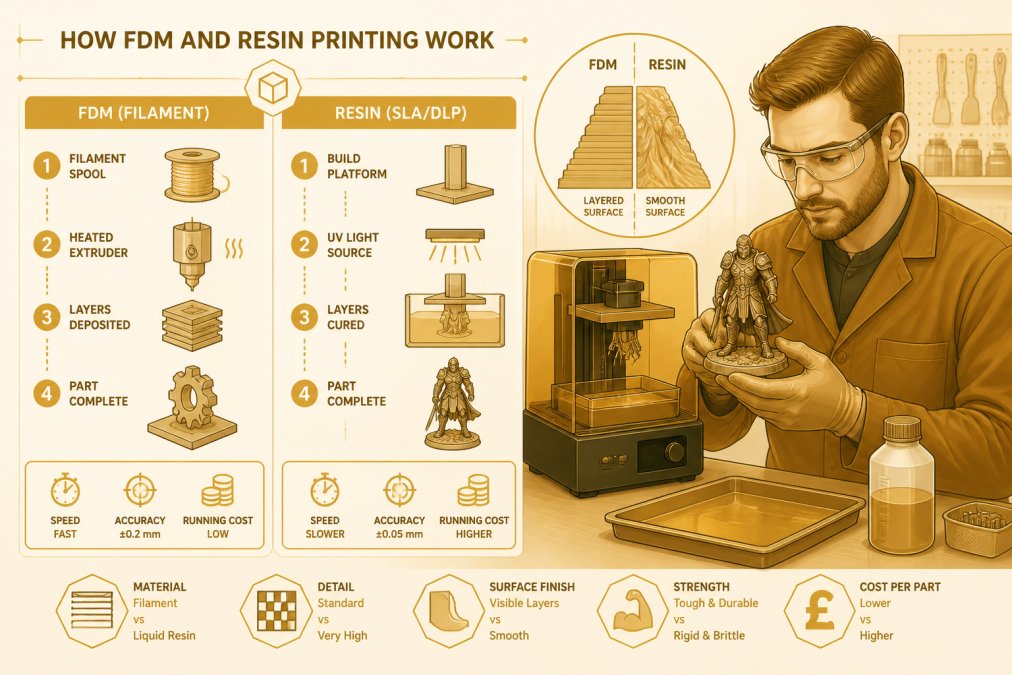
FDM and resin printing produce 3D objects through opposite processes, and understanding each is essential to choosing the right method.
FDM printing, or Fused Deposition Modelling, extrudes heated thermoplastic filament layer by layer. The printer melts plastic and deposits it through a moving nozzle, building the object from the bottom up, with each layer bonding to the one below. Load filament, set your parameters, and the machine handles the rest.
Resin printing works differently. A photopolymer resin sits in a build tank, and a light source (UV laser or LED array) selectively cures it in precise patterns. The build platform lifts after each layer to expose fresh resin, creating exceptionally fine detail because light targets micro-thin areas accurately.
The key difference: FDM is additive through extrusion; resin is additive through light-based curing. Speed, detail, material properties, and cost structure all flow from these opposing mechanisms.
Pro Tip If you're new to 3D printing, FDM feels more intuitive, it's essentially a robot that extrudes plastic. Resin printing requires more hands-on post-processing (washing, curing), but delivers results that look professionally finished straight from the printer.
Advantages of Resin 3D Printing
Resin printing excels where detail and surface finish matter most. Its layer height is typically 25-50 micrometres versus FDM's 100-200, meaning finer detail, smoother surfaces, and tighter tolerances.
Miniatures, jewellery, dental models, and small mechanical parts with intricate geometry all benefit. If your design includes fine surface detail, text smaller than 2mm, or complex internal features, resin delivers results FDM cannot match.
Surface finish is another major win. FDM prints show visible layer lines from stacked plastic beads; resin prints emerge near-glass-smooth. For aesthetic products or anything where finish affects perceived value, resin wins decisively, often needing no post-processing beyond washing and curing.
Resin also handles complex geometry better. Undercuts, thin walls, and intricate internal channels that need extensive supports in FDM are manageable in resin, with easier support removal and more geometric complexity without structural compromise.
Batch printing is another practical advantage: resin lets you pack the build platform densely, producing dozens of identical small parts in one run, while FDM's larger nozzle makes this less efficient.
Key Takeaway Choose resin when the final appearance, surface smoothness, or fine detail is your priority. If your customers or users will see the part, resin almost always looks more professional.
Advantages of FDM 3D Printing
FDM printing dominates when you need strength, size, or affordability. FDM materials (PLA, PETG, ABS, nylon) are mechanically strong and withstand stress, impact, and repeated use, while resin parts are stiffer but more brittle and can crack under sudden stress.
Filament VS Resin 3D Printing in 2025: Which is Best?
Figure Feedback
This matters for functional parts. For brackets, enclosures, clips, or load-bearing components, FDM is more reliable, with well-understood, predictable material properties that engineers trust for prototype tooling and production-intent parts.
FDM also wins on build volume. Resin printers max out around 200 x 120 x 200mm, while FDM machines routinely exceed 300 x 300 x 400mm and industrial systems go far larger. For a large enclosure, full-scale prototype, or multi-inch component, FDM is your answer.
Material cost is another decisive factor. FDM filament costs roughly £15-25 per kilogram versus £30-60 for resin, so a 500-gram part costs a fraction in FDM. For large prints or batch production, this compounds quickly.
Speed also favours FDM for large objects: resin prints at roughly the same speed regardless of size, while FDM covers large areas quickly, so a big, simple shape prints faster in FDM.
The learning curve is gentler too. FDM requires less hands-on skill and post-processing, while resin demands careful liquid handling, ventilation, washing, curing, and waste disposal. For hobbyists or small teams without dedicated facilities, FDM is more accessible.
Watch Out FDM parts require post-processing if appearance matters. Sanding, painting, or vapour smoothing adds time and cost. If your timeline is tight and finish quality is critical, budget accordingly, or choose resin instead.
Resin vs FDM Print Quality and Surface Finish
Print quality spans dimensional accuracy, surface smoothness, detail fidelity, and visual appearance, and resin and FDM excel in different areas.
Surface finish strongly favours resin. Visible layer lines define FDM prints, while resin prints emerge smooth and almost polished, the difference between a prototype that looks handmade and one that looks professionally manufactured.
Detail and resolution also favour resin. Fine features, thin walls, small holes, and delicate geometry print crisply, while FDM struggles below 2-3mm because nozzle diameter limits precision. Text, logos, and ornamental detail come out sharper in resin.
Dimensional accuracy is more nuanced. Resin achieves tighter XY tolerances because light is more precise than an extrusion nozzle, while FDM is reasonably accurate in the Z axis. For tight tolerances across all axes, resin generally wins, though modern FDM printers are improving.
Mechanical finish favours FDM. Tougher FDM parts survive handling, assembly, and use better than resin: a resin part with perfect surface finish is fragile, while an FDM part with visible layer lines is durable.
Post-processing requirements differ significantly. Resin parts need washing and curing, adding 30-60 minutes per batch. FDM parts are ready to use immediately, though a smooth, painted finish adds hours of sanding and painting. For rapid iteration, FDM's zero post-processing is valuable.
The choice here depends on whether you prioritize visual appearance or functional durability. Resin looks better; FDM lasts longer.
Resin vs FDM Cost Breakdown
Total cost of ownership includes printer cost, material cost, and consumables. Both technologies have different cost structures.
Printer cost favours FDM at entry level: a decent FDM printer costs £200-500, while resin printers start around £300-400 and climb quickly for larger machines. If budget is tight, FDM is cheaper.
Material cost strongly favours FDM. Filament runs £15-25 per kilogram, so a 500-gram print costs roughly £8-12, versus £15-30 in resin at £30-60 per kilogram.
Consumables differ. FDM needs occasional nozzles (£5-15 each) and build plates. Resin needs cleaning supplies (isopropyl alcohol), disposable gloves, and filters, so budget £50-100 monthly for a regular user.
Waste and disposal adds hidden cost. FDM waste is solid plastic, recyclable or landfill, while resin waste is liquid or semi-solid and requires proper disposal that may incur costs depending on location and volume.
Labour and time matter too. Resin printing demands post-processing time (washing, curing). FDM requires minimal hands-on time. If your time is valuable, factor in the difference.
For one-off or small-batch projects, resin's higher material cost is tolerable; for bulk production or large prints, FDM's economics dominate. Low-volume, high-detail work goes to resin; high-volume or large-part work goes to FDM.
Best Applications for Each Technology
When to Choose Resin Printing
Resin printing is the right choice when detail, finish, or complexity demands precision. Miniatures and gaming models are the classic application, and jewellery, dental models, and hearing aids all rely on resin's accuracy and finish.
Small mechanical parts with intricate geometry also benefit. Undercuts, thin walls, or internal channels need no extensive supports in resin, so precision components like gears, connectors, and sensor housings often start as resin prototypes.
Display and aesthetic products are another strong fit. When appearance drives purchasing decisions, resin's smooth, professional finish is worth the cost: custom branding items, display models, and bespoke decorative pieces all look significantly better.
Batch production of small parts is efficient in resin: 20-50 miniatures in a single run spreads material and printer cost across multiple units, valuable for custom figurines, game pieces, or small components.
At Kreative3D, we've found resin printing ideal for clients needing precision reverse engineering of small components or detailed aesthetic models. The technology excels when the brief is "make this look professional" or "capture this fine detail."
When to Choose FDM Printing
FDM printing is the right choice when you need strength, size, or affordability. Functional prototypes and tooling components benefit from FDM's material toughness, which is more forgiving than resin's brittleness for parts that will be handled, assembled, or stress-tested.
Large objects are FDM territory: enclosures, housings, structural brackets, and full-scale prototypes all benefit from FDM's larger build volumes and material strength, which resin cannot match.
Cost-sensitive projects favour FDM. For volume printing or rapid iteration, lower material cost and zero post-processing time keep budgets manageable, which is why hobbyists, students, and early-stage startups often choose FDM.
Rapid iteration and testing also suit FDM. Because prints are ready immediately, you can test, modify, and reprint quickly. Resin's post-processing adds delay. For agile product development, FDM's speed is valuable.
Functional parts for real-world use, such as clips, brackets, and mechanical components, should start as FDM, whose durability and proven mechanical properties make it the safer choice for anything used rather than displayed.
Kreative3D works with clients on both technologies, and we often recommend FDM for small-batch tooling, production-intent prototypes, and functional components where durability matters more than appearance.
Best For Resin: Miniatures, jewellery, display models, precision components where detail and finish are critical.
FDM: Functional parts, large objects, cost-sensitive projects, rapid iteration where toughness matters.
Making Your Choice: Resin vs FDM Printing
The decision between resin vs FDM printing comes down to three questions: What does your part need to do? How much detail matters? What's your budget?
If your part is decorative, aesthetic, or requires fine detail, resin wins. Miniatures, jewellery, display pieces, and precision components all benefit from resin's superior finish and resolution.
If your part is functional, large, or cost-sensitive, FDM wins: prototypes, tooling, structural components, and anything needing mechanical strength should start as FDM, whose lower cost and material toughness make it the practical choice.
If you're uncertain, consider a hybrid approach: print the mechanism in FDM and the cosmetic shell in resin, capturing the strengths of both.
Volume matters too. Single parts or small batches can justify resin's higher material cost if appearance is critical. High-volume production or large parts favour FDM's economics.
Timeline also influences the choice: FDM is faster to completion with no post-processing, while resin's washing and curing add 1-2 hours per batch. Under deadline pressure, FDM's speed is valuable.
When you're ready to move forward, Kreative3D offers expertise in both technologies.
Choosing between resin vs FDM printing is ultimately about matching the technology to your project's priorities. Resin delivers unmatched detail and surface finish for aesthetic and precision applications.
If you're designing a prototype, custom part, or small-batch production run, Kreative3D can help you choose the right technology and deliver results on your timeline.
Criteria | Resin Printing | FDM Printing |
|---|---|---|
Surface Finish | Smooth, polished, professional | Visible layer lines, requires post-processing |
Detail & Resolution | Exceptional (25-50µm layers) | Good but limited (100-200µm layers) |
Build Volume | Smaller (typically 200 x 120 x 200mm) | Larger (300+ x 300+ x 400+mm) |
Material Cost | Higher (£30-60/kg) | Lower (£15-25/kg) |
Mechanical Strength | Brittle, stiff | Tough, flexible, durable |
Post-Processing | Required (wash, cure) | Minimal |
Best For | Miniatures, jewellery, display, precision | Functional parts, large objects, cost-sensitive |
Learning Curve | Steeper (liquid handling, ventilation) | Gentler (load filament, print) |
Frequently Asked Questions
Which produces more detailed 3D prints, resin or FDM?
Resin printing typically produces finer detail and smoother surfaces than FDM. Resin printers can achieve layer heights as small as 25 micrometres, whereas FDM printers usually work with layer heights of 100-200 micrometres. This means resin is better for miniatures, intricate models, and parts where surface finish matters. FDM can handle complex geometry, but visible layer lines are more apparent and require post-processing to smooth.
Which is cheaper to use, resin or FDM printing?
FDM printing is generally more affordable. Filament costs are typically lower per kilogram than resin materials, which are more expensive per unit volume. FDM printers and filament are also widely available at lower price points. However, total cost depends on your project size, batch volume, and post-processing needs. For small, detailed parts, resin may be cost-effective despite higher material costs. Kreative3D's instant quoting tool helps you compare costs for your specific project.
Are FDM prints stronger than resin prints?
FDM prints are generally stronger and more durable for functional, load-bearing parts. FDM materials like PLA and PETG offer better mechanical strength and flexibility. Resin prints are more brittle and suitable for aesthetic models, miniatures, and parts that don't require high impact resistance. If you need a part that must withstand stress or repeated use, FDM is the better choice.
What should you consider when choosing between resin and FDM printing?
Consider your project's primary need: detail and surface finish (resin), or strength and cost-effectiveness (FDM). Also evaluate build volume requirements, post-processing tolerance, workspace ventilation needs (resin requires more careful handling), and batch size. Resin demands more safety precautions and curing time, whilst FDM is more beginner-friendly. Kreative3D specialises in both technologies and can advise which suits your design, timeline, and budget.