listicle
Small Batch Production for Startups: A 2026 Guide

Last Updated: October 16, 2026
What Is Small Batch Production and Why It Matters for Startups
Small batch production is manufacturing in limited quantities, typically 10 to 1,000 units per run, without committing to full-scale mass production. For startups, it bridges expensive one-off prototyping and mass production's capital investment.
The core advantage is flexibility: test demand, refine your design from real feedback, and adjust volumes without minimum order quantities, validating ideas before scaling.
Most startups face a brutal choice: perfect a product in isolation for months, or rush to market untested. Small batch production splits the difference, letting you manufacture enough units to gather feedback, generate revenue, and prove demand before a larger run.
Product-market fit rarely happens on the first attempt. Winning companies iterate quickly, learn from real customers, and adjust. Small batch production is the operational backbone that makes iteration possible at startup speed.
Small Batch Manufacturing vs Mass Production and Continuous Production
Understanding how small batch manufacturing differs from its alternatives clarifies when each approach makes sense.
Mass production creates thousands of identical units. Economies of scale make each item cheaper as volume increases, but tooling costs, long lead times, and minimum order quantities often exceeding 5,000 units create inflexibility and upfront risk. If the market rejects your product, you're holding expensive inventory with no recourse.
Continuous production runs 24/7 with minimal downtime, common in chemicals, pharmaceuticals, and food manufacturing. It's optimised for throughput and consistency, but unrealistic for a startup: it requires dedicated equipment, regulatory compliance, and demand that justifies the complexity.
Small batch production sits between these extremes. You manufacture in defined groups, say 50 or 200 units, with flexibility to adjust between runs. Setup costs are higher per unit, but you avoid massive capital commitment, lead times are shorter, and you can pivot quickly if feedback demands design changes.
The practical difference: mass production asks "Can we afford to make 10,000 units?" Small batch production asks "Can we afford to learn from 200 units?" For startups, the second question matters far more.
How the Batch Production Process Works
Batch production follows a structured workflow balancing efficiency with flexibility.
5 Hard Truths About Small Batch Manufacturing (That Every Startup Should Know)
CRE8
The process begins with production planning: defining batch size, timeline, and specifications. A startup might manufacture 100 units over six weeks, scheduling design finalisation, manufacturing, quality checks, and shipping.
Next comes setup: equipment configured, tooling prepared, materials sourced. For 3D printing, that means loading the right resin or filament, calibrating the printer, and preparing the build platform. Setup costs are significant, one reason small batch production costs more per unit than mass production.
The production run follows. Units are manufactured to specification, with quality control continuous rather than only at the end. Defective parts are reworked or scrapped, keeping defect rates low and preventing wasted material.
Once production completes, finishing and testing occurs: removing support material from 3D prints, sanding, painting, or assembly, then functional testing to validate each unit.
Finally, packaging and logistics prepare units for delivery, often shipping directly to customers or your warehouse.
The entire cycle typically takes two to eight weeks. That speed makes small batch production valuable: complete a full cycle, gather feedback, and begin the next batch within a product development quarter.
Batch Production Examples Across Industries
Small batch production appears everywhere once you know where to look.
Automotive restoration relies heavily on small batch manufacturing. Classic car enthusiasts need replacement parts manufacturers stopped producing decades ago. A restoration specialist might commission 50 custom door seals for a 1970s model, or 25 replica trim pieces.
Custom branding and signage is inherently small-batch. A growing retailer needs 100 custom display stands for new store locations; a restaurant opening a second site needs 50 branded menu holders. These are one-off designs manufactured in small quantities tailored to each customer.
Tooling and specialised components often run in small batches. A factory needing custom jigs, fixtures, or replacement parts can commission a small batch locally instead of waiting months for a supplier or paying premium prices for expedited orders. Lead times are weeks instead of months.
Hobbyist and maker projects demonstrate small batch production at the individual level. A designer creates a new cable organiser and manufactures 50 units to sell online; a pet product innovator produces 100 aquarium accessories to test the market.
Reef aquarium products represent a niche but growing segment. Reef keepers need custom frag racks, water flow directors, and coral holders that mass-market companies don't address.
The common thread: demand is real but volume is limited, customisation matters, and speed to market creates competitive advantage.
Rapid Prototyping for Startups: From Concept to Production Ready
Rapid prototyping is the bridge between idea and manufacturability, revealing whether your design works before committing to production.
Start with concept validation. Build a rough prototype, often by hand or with basic 3D printing, to prove the core idea is sound. It doesn't need to be perfect, just answer one question: does the concept work?
Once validated, move to design refinement. Work with a CAD designer to create detailed technical drawings documenting every dimension, tolerance, and material specification. Mistakes become expensive here: a flaw caught now costs hours of revision; the same flaw discovered during production costs money and time.
Prototype iteration comes next. Manufacture 5 to 20 refined prototypes and test them rigorously in real conditions, gathering feedback from potential customers.
Based on feedback, design adjustments happen, from minor tweaks to significant changes. The key is learning from physical prototypes, not theoretical analysis. This loop, build, test, learn, adjust, repeats until the design works.
Once confident, you're ready for small batch production. With the design locked and specifications final, your first real production run generates revenue and validates that the design translates from prototype to production without surprises.
The timeline from concept to production-ready typically spans 8 to 16 weeks. For startups, that speed means validating market demand within a single funding cycle.
3D Printing for Small Batch Production: Technology and Practical Benefits
3D printing has fundamentally changed the economics of small batch production. You no longer need expensive tooling or traditional manufacturers for small quantities, you can manufacture in-house or through a 3D printing service.
Three main 3D printing technologies dominate small batch production. FDM (Fused Deposition Modelling) is the most accessible and cost-effective, extruding plastic filament layer by layer. It's fast, affordable, and suitable for functional prototypes and production parts that don't require extreme precision or durability.
Resin printing produces higher-resolution parts with better surface finish than FDM, ideal where detail matters: intricate designs, fine features, or aesthetic appeal. It costs more than FDM but is faster than traditional manufacturing for small batches.
Metal printing offers the highest material properties, strength, heat resistance, durability, at premium cost. It's used for functional components that must withstand demanding conditions, or where metal is essential to the design.
The practical benefits are substantial. First, speed: a 3D-printed part can be in your hands within days, versus weeks or months for traditional manufacturing. Second, cost flexibility: you pay only for the material and time your batch size requires, with no tooling costs or minimum order quantities.
For startups, 3D printing democratises access to manufacturing: a small team can iterate on designs, test new ideas, and bring products to market without the capital investment traditional manufacturing demands.
Finding, Evaluating, and Working with a Small Batch Manufacturer
Choosing the right manufacturing partner can make or break a product launch.
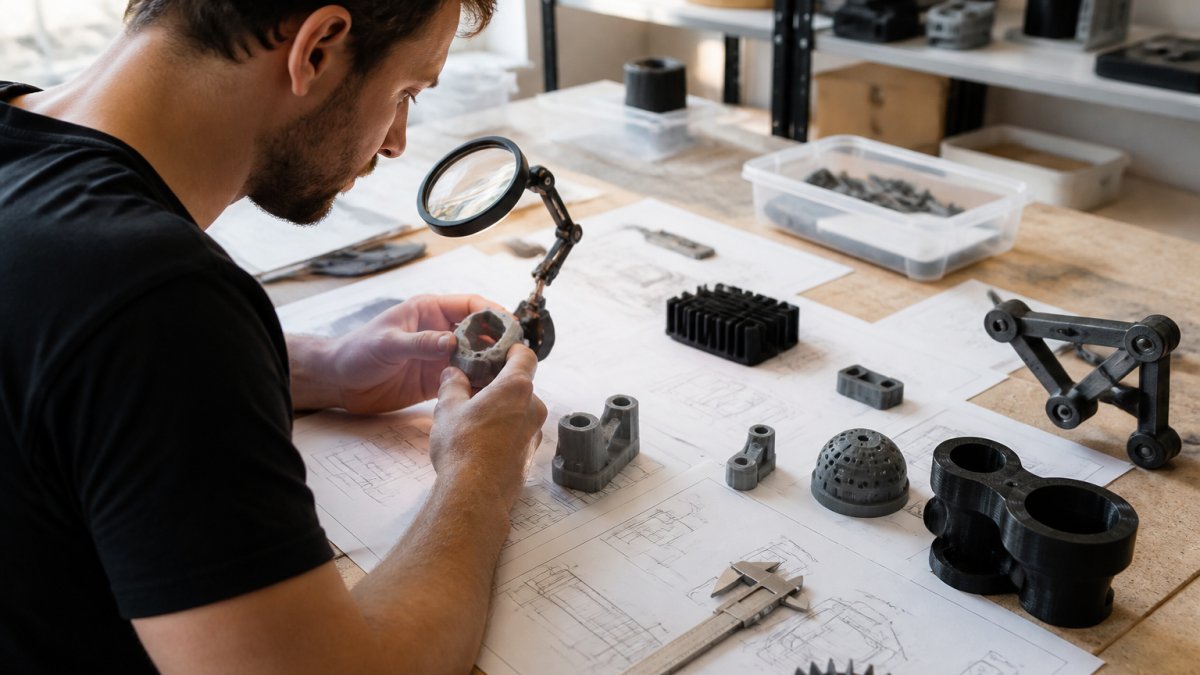
Start with capability matching. Not every manufacturer handles every type of production: some specialise in 3D printing, others in injection moulding or CNC machining.
Evaluate turnaround time. Ask directly: how long from order to delivery? A manufacturer claiming two-week turnaround for complex metal parts is either unrealistic or overpriced.
Assess quality control. Ask how they inspect parts, whether they test every unit or sample batches, and what their defect rate is. Request examples of past work for similar products.
Understand pricing structure. Transparent pricing is a green flag. Ask for a detailed quote breaking down material costs, labour, setup fees, and other charges.
Check communication and responsiveness. A manufacturer who's hard to contact before you order will be impossible to reach if a problem arises during production.
Start small. Request a pilot batch, perhaps 50 units, to validate the relationship before scaling to 200 or 500. A reputable manufacturer will welcome this approach because it builds a long-term relationship.
The goal isn't the cheapest manufacturer but a reliable partner who understands your timeline, delivers consistent quality, and communicates clearly, becoming an extension of your team.
Cost Planning, Unit Economics, and Break-Even Analysis
Understanding the true cost of small batch production is essential for financial planning. Many startups underestimate costs and end up with thinner margins than expected.
Batch size matters: a £500 setup charge is £5 per unit across 100 units, but £1 per unit across 500.
Calculate your break-even quantity, the number of units you must sell to cover all costs.
Example: You manufacture 200 units at a total cost of £2,000 (£10 per unit).
Plan for inventory carrying costs. If you manufacture 500 units but sell only 50 in the first month, you're carrying 450 units.
Account for waste and rework. Expect a 5% to 10% defect rate on your first batch. Some defective units can be reworked; others must be scrapped.
Model different scenarios. What if you sell 50% more or 50% less than expected? How does that change unit cost and profitability?
The hard truth: small batch production has higher per-unit costs than mass production. You're paying for flexibility and speed.
Cost Component | Small Batch (100 units) | Medium Batch (500 units) | Large Batch (2,000 units) |
|---|---|---|---|
Material cost per unit | £8 | £7 | £5 |
Labour per unit | £4 | £2.50 | £1.50 |
Setup cost per unit | £5 | £1 | £0.25 |
Total manufacturing cost | £17 | £10.50 | £6.75 |
This table illustrates why batch size drives unit cost. As volume increases, per-unit costs decline due to economies of scale.
At Kreative3D, we provide the expertise and technology to turn ideas into tangible products.
Frequently Asked Questions
What is the difference between small batch production and mass production?
Small batch production manufactures products in limited quantities, typically 10 to 1,000 units per run, allowing for flexibility and design changes between batches. Mass production runs tens of thousands or millions of identical units with fixed tooling and lower per-unit costs. Small batch production suits startups testing market demand, while mass production requires high upfront investment and committed demand. Lead times and setup costs differ significantly: small batches have shorter lead times but higher per-unit costs; mass production has longer lead times but economies of scale.
How quickly can a startup get a small batch production run completed?
Lead time depends on the manufacturing method and complexity. 3D printing for small batches typically takes 2 to 6 weeks from design approval to delivery, with some services offering rush options. Traditional manufacturing (injection moulding, CNC) can take 8 to 12 weeks including tooling. Simpler designs and established manufacturing relationships accelerate timelines. Instant online quoting systems can confirm feasibility within hours, helping you plan product launches around realistic manufacturing schedules.
What are the main benefits of small batch production for startups?
Small batch production reduces financial risk by allowing you to test products with real customers before committing to large-scale manufacturing. It enables rapid iteration: you can manufacture, gather feedback, and refine designs without waste. You avoid excess inventory and cash-flow strain from overproduction. Small batches also support market testing, seasonal products, and niche markets where demand doesn't justify mass production. Product variety and flexibility are key advantages, letting you respond to customer feedback and market trends quickly.
How do I estimate the cost of a small batch production run?
Costs include material, labour, setup fees, and overhead. Request quotes from multiple manufacturers with your exact specifications: material type, quantity, finish, and deadline. Setup costs (tooling, programming, first-article inspection) are divided across your batch size, so larger batches reduce per-unit cost. Factor in quality control, packaging, and shipping. Many manufacturers offer instant online quoting systems that provide transparent pricing based on your design file. Compare quoted unit costs against your target retail price to confirm profitability before committing to production.
What should I look for when choosing a small batch manufacturer?
Verify their experience with your product type and material (FDM, resin, metal, injection moulding, etc.). Check turnaround times, minimum order quantities, and whether they offer reverse engineering or CAD support if needed. Request examples of previous work and customer references. Confirm quality assurance processes, defect rates, and rework policies. Transparent pricing without hidden setup fees is essential. Ask about intellectual property protection for your design files. A manufacturer offering instant online quoting and clear communication channels reduces delays and surprises.